
Free written scope consultation - allowances, timeline, and change-order rules on paper before a single trade is scheduled


 Before
 After
After Before
 After
After Before
 After
AfterGrohe Kitchen Remodeling: The Los Angeles Owner’s Guide
Grohe kitchen remodeling in Los Angeles typically runs $16,520 to $53,100 for a full kitchen, with the faucet and fixture hardware portion accounting for roughly $300 to $1,800 of that total depending on the Grohe series you own. We stock Grohe-compatible cartridges, pull-down spray heads, and mounting hardware on our trucks, so a failing faucet rarely holds up a remodel for more than a day. Most Los Angeles homeowners discover the problem the same way: a drip that won’t stop, a handle that turns too freely, or a flow rate that’s dropped to a trickle while the rest of the kitchen functions fine. That’s not a remodel-ending event. It’s a parts match, and it’s the thing we handle most often before cabinets get touched.
Here’s the straight answer: if your Grohe fixture is failing, you don’t need a full remodel. You need the correct replacement part, matched to your exact model, installed by someone who can tell the difference between a Grohe SilkMove ES cartridge and a knockoff that will seize in six months. We’re Rowan Construction Group, an independent contractor, not affiliated with Grohe, and we write every price down before work starts.
Which Grohe Models This Applies To
Grohe has never been one faucet company. It’s several, sold under different names at different points in time, and the parts don’t cross over the way people assume. The models we see most in Los Angeles kitchens are the Ladylux, Ladylux Café, Concetto, Eurosmart, and the pull-down K7 and Minta lines. Each uses a different cartridge. A Ladylux Café cartridge will not seat correctly in a Concetto body, and forcing it ruins the brass threads inside the housing. We’ve seen that exact mistake from homeowners who bought the cheaper part online and then called us to fix the fixture properly.
The compatibility gotcha most people miss: Grohe changed their cartridge sizing in the mid-2010s on several pull-down models. If your faucet was installed before 2015, you likely need the 46mm ceramic cartridge. Post-2015, several lines moved to a 35mm or 28mm cartridge, and the only reliable way to confirm is to remove the handle and measure the brass stem diameter with calipers. The model number on the bottom of the spray head or on a sticker inside the cabinet door helps, but measurements don’t lie the way memory does. On the OEM versus aftermarket question: Grohe’s German-made cartridges carry a better ceramic disc tolerance than most aftermarket equivalents, but quality aftermarket cartridges from Flühs or Kerox (the same suppliers Grohe uses for some lines) perform identically at 40 to 50 percent less. We quote both and let the written price make the decision.
Signs Your Grohe Kitchen Remodeling Is Failing
- Constant drip from the spout after shutoff. This is almost always a worn ceramic disc surface inside the cartridge. Grohe cartridges are designed for roughly 500,000 open-close cycles, which in a busy Los Angeles kitchen means 8 to 12 years of service before drip develops.
- Handle turns with no resistance, or sticks mid-turn. Loss of the SilkMove damping grease. The cartridge still seals, but the glide feel that makes Grohe feel like Grohe is gone. It’s repairable without replacing the whole cartridge if caught early.
- Flow rate drops noticeably while other fixtures run fine. The aerator or the flow limiter inside the pull-down wand is clogged with mineral scale. Los Angeles water runs moderately hard in most neighborhoods, and Grohe’s fine-mesh aerators catch scale faster than cheaper faucets do.
- Pull-down hose won’t retract, or retracts too hard. The counterweight inside the cabinet has slipped, or the hose has worn a groove from rubbing against the cabinet cutout. This is the most common non-cartridge failure we find on Grohe pull-downs.
- Water leaks from under the handle only when the faucet runs. A failing O-ring on the cartridge stem, not the cartridge itself. It’s a five-dollar part and twenty minutes of work if you don’t let it score the stem.
BeforeAfterReplacement Cost & What’s Included
For Grohe-specific work as part of a kitchen remodel in Los Angeles, expect these installed price ranges:
- Cartridge replacement: $180 to $420 installed, depending on OEM versus quality aftermarket and the series.
- Pull-down hose and spray head replacement: $220 to $480 installed.
- Full faucet swap to a new Grohe model: $450 to $1,800 installed, faucet included.
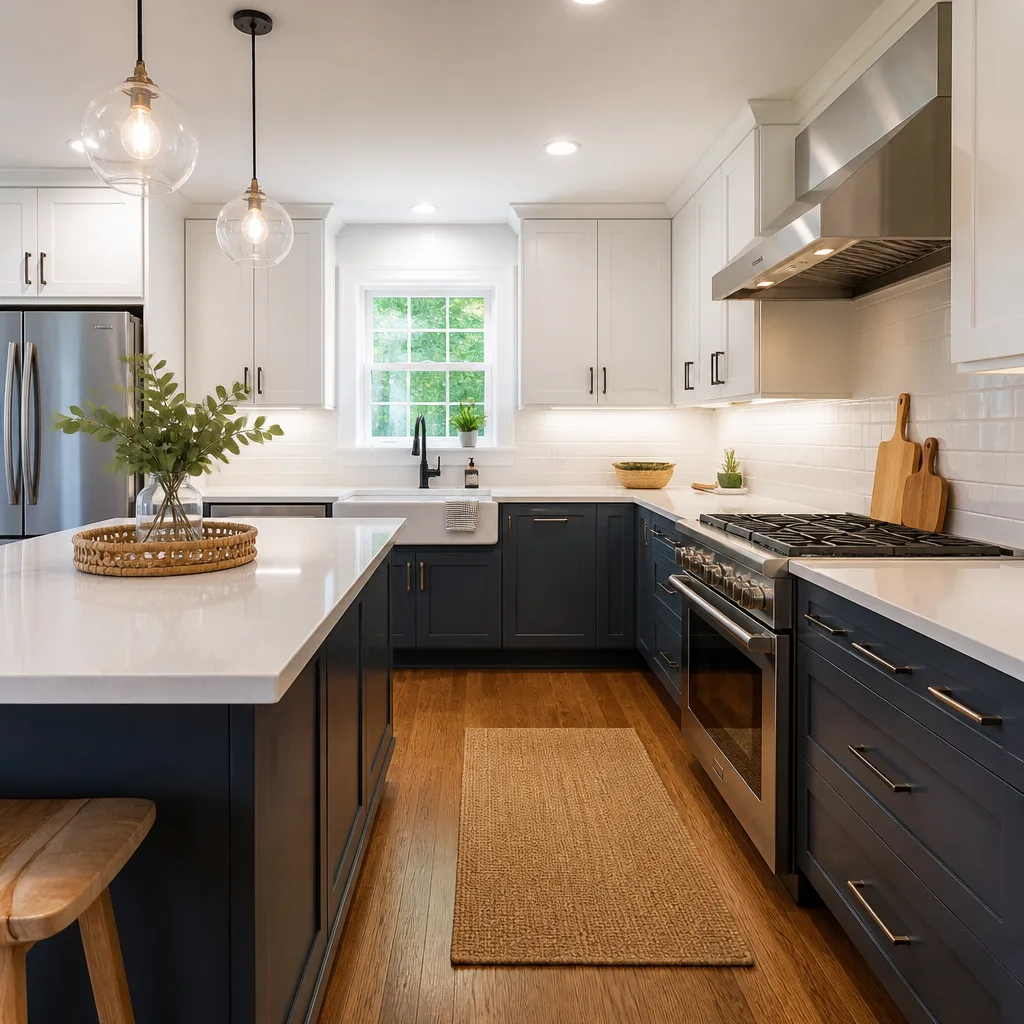
- Full kitchen remodel with Grohe fixtures: $16,520 to $53,100, line-itemed for parts, labor, cabinets, counters, and fixtures.
What drives the range is the series you own and what else the remodel touches. A cartridge-only job is a flat, small number. A kitchen where you’re replacing the Grohe faucet as part of moving the sink, cutting new countertops, and rewiring the island is a different line item entirely. Every quote we write separates parts from labor, names the exact cartridge or part number, and includes a written warranty on the work. Under Clause 1 of the Haven Standard, the price is written before anyone starts. There is no “call for a quote” here. The number arrives in writing, with a signed change order required before anything beyond that number is ever done.
DIY or Call Us?
Replacing a Grohe cartridge is not dangerous. It is, however, easy to get wrong in a way that costs more than having it done correctly. The most common DIY failure we see in Los Angeles is over-tightening the brass retaining ring and cracking the faucet body, at which point the entire fixture needs replacement. If you want to check something yourself before calling, remove the aerator from the spray head and soak it in vinegar overnight. That is low-risk, and it sometimes solves the flow problem entirely. The cartridge itself? Leave that to someone who has done a few hundred of them. We’re at (470) 298-9650, and a live person answers.
FAQs
A Grohe kitchen faucet in Los Angeles typically lasts 10 to 15 years before the cartridge develops a drip, assuming it’s cleaned and maintained. Los Angeles water hardness shortens that by a year or two compared to softer-water cities, but Grohe’s ceramic discs handle it better than most. Call (470) 298-9650 if yours is dripping sooner; sometimes the fix is a five-dollar O-ring.
Yes, in some cases. If the handle has lost its glide but doesn’t drip, the damping grease inside the SilkMove mechanism can often be refreshed without a full cartridge swap. If it’s dripping, the ceramic discs are worn and the cartridge itself gets replaced; there’s no resurfacing a ceramic disc. Call (470) 298-9650 and describe the symptom, and we’ll tell you which one you’re looking at.
Most cartridge replacements and faucet swaps take 45 to 90 minutes of on-site work, including testing and a photo record of the finished job. If the work is part of a larger kitchen remodel, the faucet work happens on a scheduled day alongside the other trades. Every visit includes a documented photo record, standard, not optional.
Yes. We keep the most common Los Angeles Grohe cartridge sizes, pull-down hoses, spray heads, and O-ring kits on the truck, which means most faucet repairs are completed same-day without a return trip. For less common Grohe series, we order the part and return within the week. We also stock and install KraftMaid cabinets, Cambria and Silestone countertops, and the full kitchen remodel scope, so the faucet is never the thing that stalls the job.
If your Grohe fixture is failing and you want a number on paper before anyone touches the sink, call (470) 298-9650. We’ll quote the part, the labor, and the warranty in writing. Measure twice, say it once, show your work.
Written by Grant Rowan, Owner, Rowan Construction Group at Rowan Construction Group, serving Los Angeles and nearby areas.