
Free written scope consultation - allowances, timeline, and change-order rules on paper before a single trade is scheduled
 Before
 After
After Before
 After
After Before
 After
AfterTuff Shed Roofing: The Los Angeles Owner’s Guide
We stock and install Tuff Shed-compatible roofing across Los Angeles, with most replacement jobs running $470 to $2,125 installed. The roofing on a Tuff Shed is not the same as house roofing: it’s thinner-gauge pre-painted steel or a shingle-over-plywood system matched to the shed’s specific eave and ridge profile, and when it fails it fails in ways that look different from a house roof. Most Los Angeles owners discover the problem after a winter rain when water is dripping onto stored boxes or when a gust of Santa Ana wind peels a corner and the panel starts flapping. The short version: if your Tuff Shed roof is leaking, rusted through, or lifting at the fasteners, the fix is usually a same-day panel replacement or a half-day ridge and eave rebuild, and we carry the common profiles on the truck.
We’re an independent Los Angeles contractor. We are not affiliated with Tuff Shed, and we’ve never claimed to be. What we do is match the roofing systems Tuff Shed has shipped over the last two decades and quote the replacement in writing, in dollars, before we touch a fastener.
Which Tuff Shed Models This Applies To
Over the years, Tuff Shed has shipped three basic roofing systems you’ll find on Los Angeles properties. The Premier Ranch and Sundance Ranch lines use a 26-gauge painted steel panel with a 3/4-inch trapezoidal rib profile, usually 36 inches wide. The Pro Ranch and Tall Ranch lines use the same metal panel but with a higher eave height, so the roof pitch is steeper and flashings are cut differently. Their shingle-roof builds, which are less common here, use a standard 3-tab or architectural shingle over 7/16-inch OSB decking on a pre-built truss system.
The compatibility gotcha nearly every Los Angeles owner hits is this: a panel from Home Depot or Lowe’s will not mate correctly with the Tuff Shed rib spacing or the factory ridge cap. The ribs are close but not identical; when you force it, you get a water trough at the lap joint and a ridge cap that does not seat. We have hundreds of these panels in Los Angeles roofs, and the repair follows the same rule every time: match the profile, not just the color. If you’re not sure which series you own, look at the metal tag on the inside gable near the door. The second line is the build date, and the model name is on the first line. Send us a photo of that tag and the roof from the side, and we’ll identify the part before we quote anything.
One more thing worth saying: for Tuff Shed metal roofs specifically, the original factory panel is often fine to reuse if the failure is at the screws or the eave trim. That means the OEM-vs-aftermarket decision is actually a secondary question. The primary question is whether the panel itself is compromised or whether the fastening system around it failed first. Los Angeles sun is hard on the neoprene washers under the roof screws. We replace screws and washers as a first step more often than we replace panels.
Signs Your Tuff Shed Roofing Is Failing
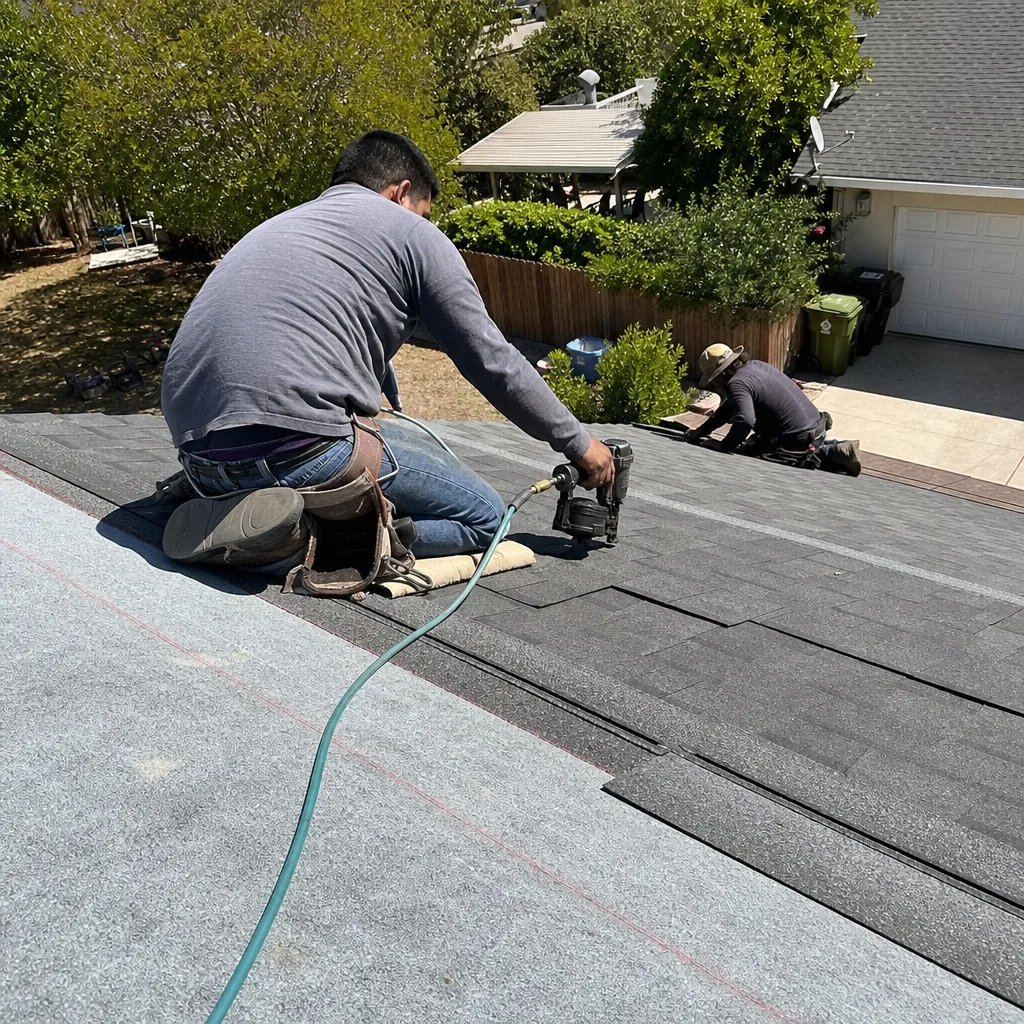
- Water staining on the underside of the roof deck or wet boxes along the walls. This almost always traces to one of two places: a failed lap seal between metal panels, or a rusted-through screw washer at a low point in the roof slope. In Los Angeles, the failure is rarely from rain volume; it’s from years of UV breaking down the rubber washers.
- A visible rust line along the eave edge or at the ridge cap. Tuff Shed panels are galvanized and painted, but the cut edges at the eave are exposed raw steel from the factory. Add coastal moisture in places like Playa del Rey or San Pedro, and that edge rusts first. The panel above it is usually still salvageable, but the eave trim has to go.
- Flapping or rattling in wind. The screws have backed out or the washers have crumbled, and the panel is now held only by its neighbors. Every Santa Ana season we get a wave of these calls, and the repair is fast and inexpensive if it’s caught before the panel creases.
- Daylight through a gap between the ridge cap and the panel. This means the ridge cap fasteners have pulled, or the cap itself has warped. In Los Angeles sheds with a high roof pitch, this gap funnels the rare downpour directly onto the ridge beam, and the damage runs down the wall the first winter it really matters.
- Granules from the shingles collecting at the base of the shed or in the gutters. On Tuff Shed shingle builds, the shingles are contractor-grade and usually outlast the shed’s intended lifespan, but if you see granule loss before year ten, check the roof for hail damage or bad decking, and then check the eave flashing, because that’s the part that fails before the shingle layer does.
BeforeAfterReplacement Cost & What’s Included
In Los Angeles, a Tuff Shed roof repair typically runs between $470 and $2,125 depending on what actually failed. A screw-and-washer replacement across the entire roof, with new eave trim where needed, sits at the low end. Replacing one or two metal panels, including color matching the existing roof and resealing the laps, runs in the middle. A full re-roof of the shed, including the ridge cap, eave trim, and all new fasteners, hits the high end. The number that matters is the written one on the page: that’s the price you get before we start, and it does not change because the crew found something unexpected, because under Clause 1 of the Haven Standard, the price is written before anyone starts. If the scope does need to change, no work proceeds until you sign the change order. That’s the rule, not the exception.
What drives the range is three things: the number of panels that need to go, whether the eave and ridge trim can be saved, and the roof pitch, because we don’t walk metal roofs the way we walk shingle roofs, and steep access slows the job down. The warranty on the work is the same on every repair: if it’s not done right, we make it right. The 365-Day Done Right Promise is on every written quote, in the same place on the page.
DIY or Call Us?
There are things you can safely check yourself, and then there’s the point where you should stop. You can photograph the label inside the gable, take clear shots of the rust line or the failed screw, and email them to us with the shed’s dimensions. You can run a hose over the roof and watch where water enters. But we’d advise against getting on a shed roof in Los Angeles heat, because a single sheet of corrugated metal with failing fasteners is not a walking surface, and a fall from an eight-foot eave onto a concrete pad is a hospital visit. Screws and washers seem simple, but tighten the wrong one first on a metal panel roof and you’ll crack the paint, or strip a hole, or misalign the lap so the next rain finds the gap.
If you want to understand the job before anyone gets on the roof, call us. That’s what we do. We’ll walk the roof with you, point to the failed part, name it, and hand you a written scope with a flat number. If you’d rather get an estimate by text, we’ll do that too, but the number is still written before work starts. That’s not a convenience. That’s how this works.
FAQs
In Los Angeles, a Tuff Shed metal panel roof typically lasts 20 to 30 years, but the screws and neoprene washers fail well before that, usually between years 8 and 15 depending on sun exposure and how close you are to the coast. The shingle-roof versions run 15 to 20 years, with the eave flashing failing first. If your shed roof is older than that and leaking, replacement is the better money. Call (470) 298-9650 and we’ll tell you which situation you’re in after one look.
Yes, and in our experience most Tuff Shed roof failures are repairs, not full replacements. A screw-and-washer job or a single-panel swap resolves a large share of Los Angeles shed leaks. The honest exception is when rust has advanced through the panel, or a wind event has creased the metal, or the deck on a shingle roof is soft; at that point, patching is wasting money. The most common repair we recommend first is taking a competitor’s quote and bringing it to us for a line-by-line review, because the problem is usually smaller than the first quote makes it sound.
A single-panel replacement is a two-to-three hour job including cleanup and the photo record. A full Tuff Shed re-roof is a one-day job for a standard 10-by-12 or 12-by-16 shed. We’d rather take the extra hour and document the whole thing than rush the fasteners; that’s the standard, not the aisle.
We stock the common 36-inch Tuff Shed metal panel profiles, ridge caps, eave trim, and screw-and-washer kits on the truck, along with compatible shingle and flashing materials. If your panel is a less common color or profile, we order it and quote the lead time honestly before you spend anything. And if you have a KraftMaid cabinet hinge, a Cambria countertop, or a Silestone sink that’s also giving you trouble, ask about those too, because we maintain that parts depth across more than fifty brands, not just roofing.
No. The written price on the quote is the price on the invoice unless you sign a change order authorizing additional work. When a crew gets on a roof and finds that the deck beneath is soft, you’ll get a written change order with a new number, and no work proceeds until you approve it. That change-order discipline is why our projects finish within a few percent of the agreed cost. It’s also why we put the price in writing before anyone picks up a tool.
Measure twice, say it once, show your work. That’s the way Grant Rowan has run jobs since 2007, and it’s the way we handle Tuff Shed roof repairs for Los Angeles homeowners today. Call (470) 298-9650 for a free estimate, a second opinion, or just to get a clear answer about what’s going wrong on your shed roof.
Written by Grant Rowan, Owner, Rowan Construction Group at Rowan Construction Group, serving Los Angeles and nearby areas.